Understanding Liver Health and Detoxification: Supporting the Body’s Natural Balance
- Elixir

- Apr 27
- 4 min read
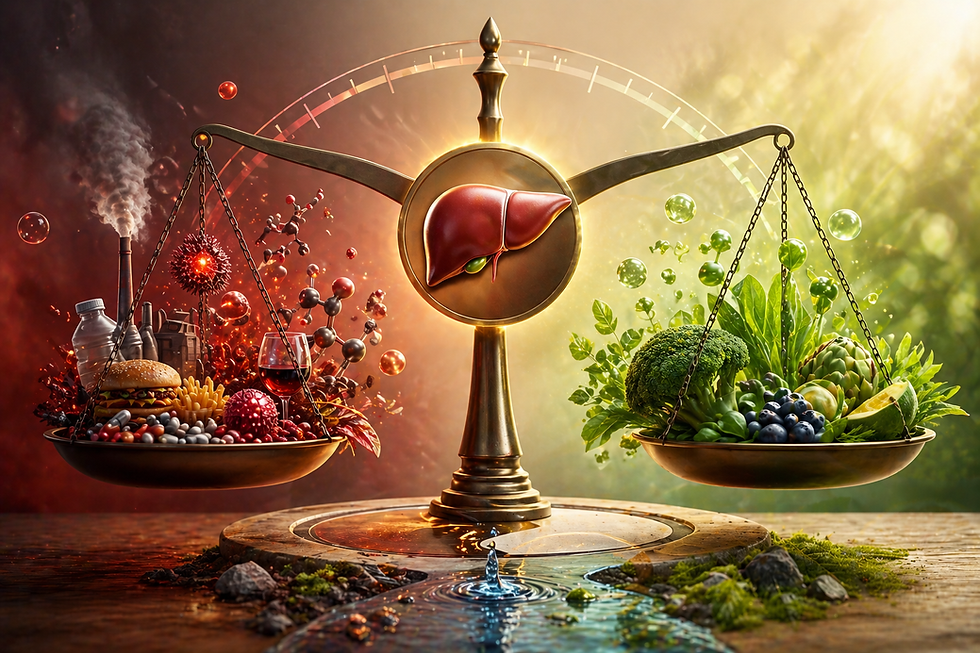
The concept of detoxification is often misunderstood as something that needs to be activated or forced. In reality, detoxification is a continuous and essential function of the body, occurring every day without interruption. From the moment nutrients are absorbed to the processing of environmental exposures and metabolic byproducts, the body is constantly working to maintain internal balance.At the center of this process is the liver. Acting as a highly sophisticated processing system, the liver helps transform substances into forms that can either be used by the body or safely eliminated. This is not a passive role, but an active and dynamic one, requiring coordination between multiple systems including metabolism, digestion, and cellular protection.
Understanding liver health, therefore, is less about adding complexity and more about recognizing how the body already functions—and how those processes can be supported.
The Liver as a Processing System
The liver receives nutrients and compounds directly from the digestive system and serves as a checkpoint before these substances circulate throughout the body. It determines what is useful, what needs to be stored, and what must be modified or removed.
This work happens through a sequence of reactions often described in two stages. First, compounds are broken down into intermediate forms. Then, they are combined with other molecules so they can be safely excreted. Both stages are necessary, and both depend on the availability of specific nutrients and internal resources.
When these processes are balanced, the body can efficiently manage what it encounters. When they are not, the system may become less efficient, placing additional strain on cellular function.
Maintaining Balance During Detoxification
As part of normal metabolism, the liver produces byproducts that must be carefully managed. This is not a sign of dysfunction, but a natural consequence of processing substances.
To maintain balance, the body relies on internal protective systems. These systems help neutralize byproducts, reduce stress on cells, and support ongoing metabolic activity. Their effectiveness depends on having the right building blocks available—particularly certain nutrients and compounds that support cellular stability.
Rather than accelerating detoxification, the body benefits more from maintaining the conditions that allow these processes to function smoothly.

The Role of Amino Acids and Nutrient Building Blocks
Many of the liver’s processes depend on amino acids, the basic components of protein. These molecules are used not only to build tissues but also to support the pathways involved in processing and eliminating substances.
For example, certain amino acids help bind compounds so they can be safely removed from the body. Others contribute to maintaining the body’s internal balance during periods of increased metabolic activity.
In addition to amino acids, vitamins and minerals play important supporting roles. Nutrients such as B vitamins, vitamin C, and magnesium help facilitate the reactions that occur within liver cells. Without adequate levels of these nutrients, these processes may become less efficient.
Plant Compounds and Cellular Support
Beyond essential nutrients, naturally occurring compounds found in plants have been studied for their interaction with the body’s internal systems. These compounds, often referred to as polyphenols or flavonoids, are not required in the same way as vitamins or minerals, but they can support the environment in which metabolic processes occur.
They may help maintain cellular balance, support normal inflammatory responses, and contribute to overall metabolic function. Their role is not to replace the body’s natural systems, but to complement them.
The Importance of Digestion and Elimination
Detoxification does not end in the liver. Once substances are processed, they must be eliminated from the body. This step is just as important as the initial transformation.
The digestive system plays a central role in this process, particularly through the movement of substances into the intestines for removal. Efficient elimination depends on factors such as gut health, regular digestion, and microbial balance.
If elimination is not functioning properly, the body may have difficulty fully clearing what it has processed. This highlights the importance of supporting the entire system, not just one part of it.
Hydration and Daily Function
Water is one of the simplest yet most essential components of maintaining balance in the body. It supports circulation, helps transport nutrients, and plays a role in the removal of waste products.
Adequate hydration allows the body’s systems to function more efficiently. Without it, even well-functioning processes may become slower or less effective.
A Broader Perspective on Liver Health

One of the most important ideas in understanding detoxification is that the body operates as a system. The liver does not function independently—it depends on the health of other systems, including digestion, nutrient status, and overall metabolism.
Supporting liver health, therefore, is not about focusing on a single intervention. It is about maintaining the conditions that allow the body to function as it was designed to.
This perspective shifts the focus away from trying to “do more” and toward supporting what is already happening.
Detoxification is a continuous and natural function of the body, centered in the liver but supported by a network of interconnected systems. These processes rely on the availability of nutrients, the efficiency of digestion and elimination, and the body’s ability to maintain internal balance.
By focusing on these foundational elements, it becomes possible to support liver function in a way that is both effective and sustainable. Rather than forcing the process, the goal is to create an environment in which the body can carry out its natural functions with greater ease.
Understanding this approach provides a clearer, more grounded perspective on what it truly means to support detoxification and overall health.
References
Lu, S. C. (2013). Glutathione synthesis. Biochimica et Biophysica Acta, 1830(5), 3143–3153. https://doi.org/10.1016/j.bbagen.2012.09.008
Samuni, Y., Goldstein, S., Dean, O. M., & Berk, M. (2013). The chemistry and biological activities of N-acetylcysteine. Biochimica et Biophysica Acta, 1830(8), 4117–4129. https://doi.org/10.1016/j.bbagen.2013.04.016
Wu, G. (2013). Functional amino acids in nutrition and health. Amino Acids, 45(3), 407–411. https://doi.org/10.1007/s00726-013-1500-6
Abenavoli, L., et al. (2018). Milk thistle for liver diseases. World Journal of Gastroenterology, 24(3), 292–301. https://doi.org/10.3748/wjg.v24.i3.292
Baur, J. A., & Sinclair, D. A. (2006). Therapeutic potential of resveratrol. Nature Reviews Drug Discovery, 5(6), 493–506. https://doi.org/10.1038/nrd2060
Li, Y., Yao, J., Han, C., et al. (2016). Quercetin, inflammation and immunity. Nutrients, 8(3), 167. https://doi.org/10.3390/nu8030167
Guengerich, F. P. (2008). Cytochrome P450 and chemical toxicology. Chemical Research in Toxicology, 21(1), 70–83. https://doi.org/10.1021/tx700079z


Comments