What Are Peptides and Why Do They Matter for Men's Health?
- Elixir

- Apr 27
- 4 min read
Updated: May 3
Peptides have gained attention in the athletic and wellness communities for their potential to enhance physical performance, support recovery, and improve overall health. For men focused on athletic excellence, understanding how peptides like BPC 157, Semorelin, and NAD work can open new doors to optimizing health safely. This post explores these peptides, their benefits, risks, and the importance of proper medical oversight.
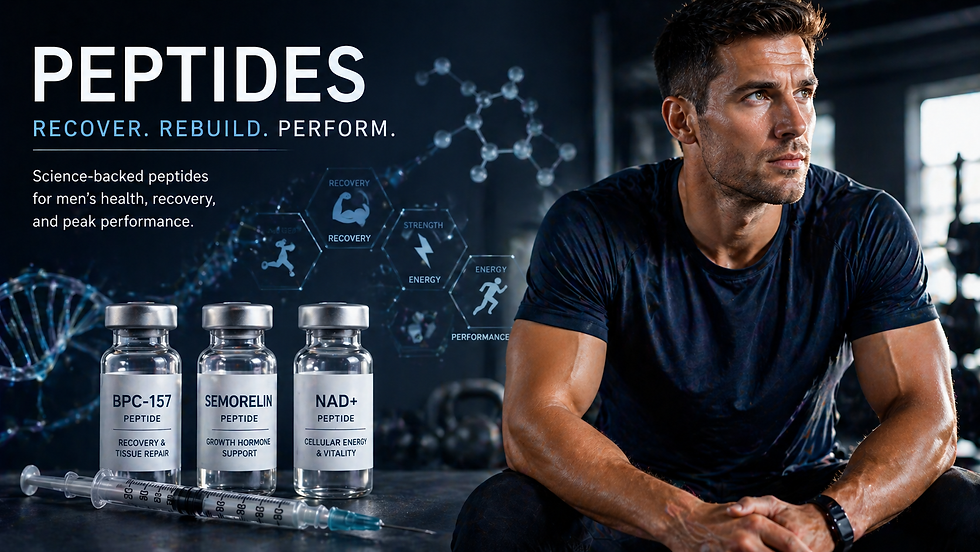
Peptides are short chains of amino acids that act as signaling molecules in the body. They regulate various biological functions, including hormone release, tissue repair, and metabolism. Unlike steroids or synthetic drugs, peptides often mimic natural processes, which can make them relatively safe when used correctly.
For men pursuing athletic goals, peptides offer a way to support muscle growth, speed up injury recovery, and boost energy levels. However, their effectiveness depends on the specific peptide, dosage, and individual health status.
BPC 157: Healing and Recovery Support

BPC 157 is a peptide derived from a protein found in the stomach. It has shown promise in accelerating healing of muscles, tendons, and ligaments. Athletes often use BPC 157 to recover faster from injuries or intense training sessions.
Benefits of BPC 157
Promotes tissue repair and regeneration
Reduces inflammation in injured areas
Supports gut health, which is crucial for nutrient absorption and immune function
Risks and Considerations
Limited long-term human studies; most data comes from animal research
Possible side effects include mild irritation at injection sites
Should only be used under medical supervision to avoid misuse
Semorelin: Boosting Growth Hormone Naturally

Semorelin is a peptide that stimulates the pituitary gland to release growth hormone. Growth hormone plays a key role in muscle mass, fat metabolism, and energy levels. Semorelin therapy can help men with age-related decline in growth hormone production.
Benefits of Semorelin
Enhances muscle growth and strength
Improves sleep quality and energy
Supports fat loss and metabolic health
Risks and Considerations
May cause headaches, flushing, or dizziness in some users
Requires careful dosing and monitoring to avoid excessive hormone levels
Not suitable for individuals with certain cancers or hormone-sensitive conditions

NAD: Cellular Energy and Anti-Aging Support
Nicotinamide adenine dinucleotide (NAD) is a coenzyme involved in cellular energy production. NAD levels decline with age, affecting metabolism and recovery. NAD therapy aims to restore these levels, potentially improving stamina, mental clarity, and overall vitality.
Benefits of NAD Therapy
Boosts cellular energy and metabolism
Supports brain function and cognitive health
May reduce fatigue and improve recovery times
Risks and Considerations
Intravenous NAD therapy requires professional administration
Possible side effects include nausea or flushing during infusion
Effectiveness varies; more research is needed to confirm long-term benefits
The Importance of Proper Health Screening and Medical Management
Using peptides safely requires more than just purchasing and injecting them. Proper health screening is essential to identify underlying conditions that could affect treatment safety. Blood tests, hormone panels, and physical exams help tailor peptide therapy to individual needs.
Medical management ensures correct dosing, monitors side effects, and adjusts treatment based on progress. Self-prescribing or using peptides without guidance increases risks of adverse effects and ineffective results.
Practical Tips for Men Considering Peptide Therapy
Consult a healthcare professional experienced in peptide therapy
Get comprehensive health screening before starting treatment
Follow prescribed dosages and schedules strictly
Monitor your body's response and report any side effects promptly
Combine peptide therapy with balanced nutrition, exercise, and rest

Final Thoughts on Peptides for Men's Athletic Health
Peptides like BPC 157, Semorelin, and NAD offer promising benefits for men seeking to improve athletic performance, recovery, and overall health. When used responsibly and under medical supervision, they can support the body's natural processes without the risks associated with some other performance-enhancing substances.
Before starting peptide therapy, prioritize thorough health screening and ongoing medical management. This approach maximizes benefits while minimizing risks, helping you unlock your peak performance safely and effectively
References
Sikiric, P., Seiwerth, S., Rucman, R., Kolenc, D., Vuletic, L. B., Drmic, D., & Petrovic, I. (2011). Stable gastric pentadecapeptide BPC 157: Novel therapy in gastrointestinal tract. Current Pharmaceutical Design, 17(16), 1612–1632. https://doi.org/10.2174/138161211797904238
Sikiric, P., Hahm, K. B., Blagaic, A. B., Tvrdeic, A., Pavlov, K. H., Petrovic, I., & Seiwerth, S. (2016). Stable gastric pentadecapeptide BPC 157 and the central nervous system. Neuroscience & Biobehavioral Reviews, 63, 1–19. https://doi.org/10.1016/j.neubiorev.2016.02.001
Veldhuis, J. D., & Bowers, C. Y. (2003). Human GH pulsatility: An ensemble property regulated by age and gender. Journal of Endocrinological Investigation, 26(9), 799–813. https://doi.org/10.1007/BF03345230
Chapman, I. M. (2004). Growth hormone and aging: A physiological perspective. Endocrine Reviews, 25(2), 211–235. https://doi.org/10.1210/er.2003-0021
Elhassan, Y. S., Kluckova, K., Fletcher, R. S., Schmidt, M. S., Garten, A., Doig, C. L., Cartwright, D. M., Oakey, L., Burley, C. V., Jenkinson, N., Wilson, M., Lucas, S. J. E., Akerman, I., Sevin, D. C., Turnbull, D. M., Latorre-Pellicer, A., & Philp, A. (2019). Nicotinamide riboside augments the aged human skeletal muscle NAD+ metabolome and induces transcriptomic and anti-inflammatory signatures. Cell Reports, 28(7), 1717–1728.e6. https://doi.org/10.1016/j.celrep.2019.07.043
Yoshino, J., Baur, J. A., & Imai, S. I. (2018). NAD+ intermediates: The biology and therapeutic potential of NMN and NR. Cell Metabolism, 27(3), 513–528. https://doi.org/10.1016/j.cmet.2017.11.002
Verdin, E. (2015). NAD+ in aging, metabolism, and neurodegeneration. Science, 350(6265), 1208–1213. https://doi.org/10.1126/science.aac4854
Goldstein, A. L., & Kleinman, H. K. (2015). Advances in the basic and clinical applications of thymosin β4. Expert Opinion on Biological Therapy, 15(Suppl 1), S139–S145. https://doi.org/10.1517/14712598.2015.1014792
Note. Research on peptides such as BPC-157 and growth hormone–releasing therapies is largely based on preclinical or early-stage human studies. NAD-related therapies are an active area of research but continue to evolve. All peptide therapies should be administered under the supervision of a qualified healthcare professional.


Comments