Comprehensive Functional Medicine Lab Testing for Personalized Supplementation
- Elixir

- Apr 27
- 5 min read
The Foundational Role of Hydration in Human Health

In recent years, there has been a growing shift in healthcare toward more individualized approaches. Rather than relying solely on generalized recommendations, many practitioners and researchers are focusing on how biological variability influences health outcomes. This shift has brought increased attention to comprehensive laboratory testing and its role in guiding more precise nutritional and lifestyle interventions.
At the same time, one of the most fundamental aspects of human physiology—hydration—continues to be underappreciated, despite its central role in nearly every biological process. When considered together, advanced lab testing and hydration provide a useful framework for understanding how to support health in a more targeted and effective way.
Rethinking the Purpose of Laboratory Testing
Traditional laboratory testing is primarily designed to identify disease. Values are typically interpreted within broad reference ranges, and results are often considered “normal” unless they fall outside those limits. However, this approach may overlook more subtle imbalances that can still affect how a person feels and functions.
Comprehensive or functional laboratory testing expands on this model by examining a wider range of biomarkers and interpreting them in the context of overall physiological performance rather than disease alone. These panels may include assessments of micronutrient status, hormonal balance, inflammatory markers, metabolic function, and gastrointestinal health.
The value of this approach lies in its ability to detect patterns. For example, mild nutrient deficiencies, early changes in glucose regulation, or low-grade inflammation may not be clinically diagnostic, but they can still contribute to fatigue, impaired cognition, or reduced resilience over time. Identifying these patterns allows for earlier and more targeted intervention.

From General Supplementation to Individualized Support
The widespread use of dietary supplements reflects an increasing interest in proactive health management. However, without objective data, supplementation often relies on generalized assumptions rather than individual need.
This can lead to inconsistent outcomes. Some individuals may experience benefits, while others see little change or take supplements that are unnecessary for their physiology.
When supplementation is guided by laboratory data, it becomes more precise. For instance, identifying a specific micronutrient deficiency allows for targeted repletion, while recognizing patterns of oxidative stress or metabolic inefficiency may inform broader nutritional strategies. Similarly, understanding hormonal or gastrointestinal imbalances can influence both the type and effectiveness of supplementation.
This data-driven approach helps align interventions with underlying biology, which can improve both effectiveness and efficiency over time.
Hydration as a Fundamental Physiological Variable
While advanced diagnostics provide valuable insight, hydration remains one of the most basic and essential components of health. Water is involved in nearly every physiological process, including cellular metabolism, nutrient transport, temperature regulation, and waste removal.
At the cellular level, adequate hydration supports the structure and function of cells. It facilitates enzymatic activity, helps maintain electrolyte balance, and plays a role in energy production within mitochondria. Without sufficient hydration, these processes become less efficient.
Despite its importance, hydration is often approached in a generalized way, with recommendations based on broad intake guidelines rather than individual variability.
The Effects of Inadequate Hydration
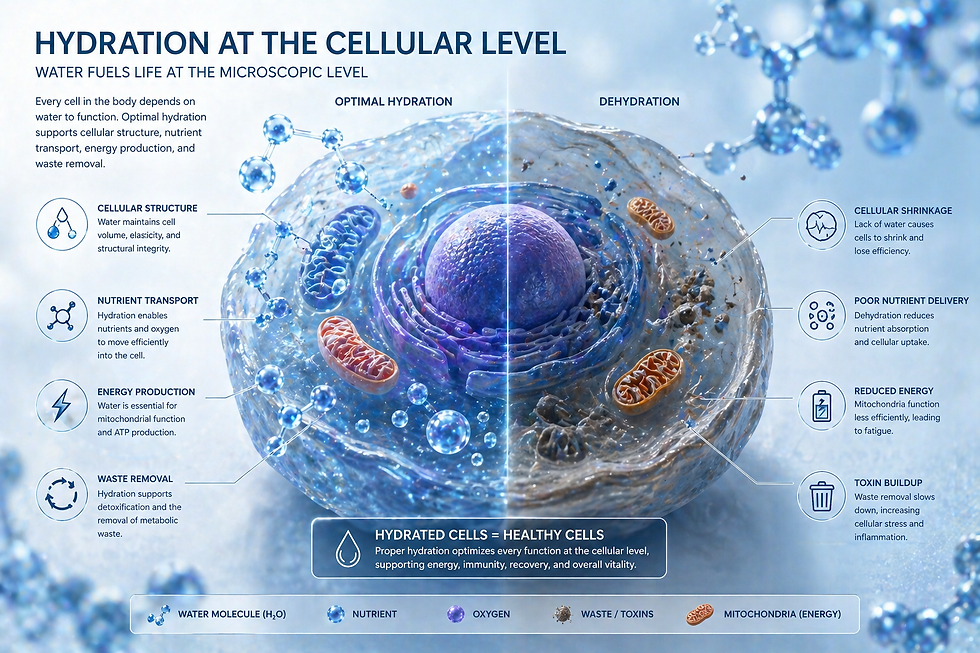
A growing body of research has demonstrated that even mild dehydration can influence both physical and cognitive performance. Studies have shown associations between low hydration status and reduced attention, increased fatigue, and decreased endurance.
Physiologically, inadequate hydration can affect cardiovascular function, alter hormonal responses, and reduce the efficiency of renal processes involved in filtration and detoxification. Over time, chronic low fluid intake may contribute to increased physiological strain, even in the absence of overt symptoms.
Importantly, hydration status is not always obvious. Standard blood markers may remain within normal ranges, while more sensitive indicators—such as urine concentration or osmolality—suggest suboptimal hydration.
Individual Variability in Hydration Needs
Just as nutrient requirements vary between individuals, so do hydration needs. Factors such as body composition, activity level, environmental conditions, and metabolic rate all influence fluid requirements.
Electrolyte balance also plays a critical role. Water intake alone does not fully determine hydration status; the distribution and retention of fluid within the body depend on sodium, potassium, and other electrolytes. This is particularly relevant for individuals who engage in regular physical activity or are exposed to heat.
These variables highlight the importance of viewing hydration as a dynamic and individualized component of health, rather than a fixed recommendation.
Integrating Laboratory Data and Hydration
When laboratory testing and hydration are considered together, they offer a more comprehensive view of physiological function. For example, nutrient absorption and transport are influenced by fluid balance, while metabolic processes identified through lab testing may depend on adequate cellular hydration to function optimally.
Similarly, interventions designed to correct deficiencies or improve metabolic health may be less effective if hydration is not addressed. In this sense, hydration can be viewed as a foundational factor that supports the effectiveness of more targeted strategies.

A Systems-Based Perspective on Health
The integration of detailed laboratory data with foundational physiological factors reflects a broader systems-based perspective on health. Rather than focusing on isolated variables, this approach considers how different systems interact and influence one another.
By identifying imbalances early and addressing them in a coordinated way, it becomes possible to support energy production, cognitive function, and overall resilience more effectively. This perspective also emphasizes ongoing evaluation, recognizing that physiological needs can change over time
The increasing availability of comprehensive laboratory testing has made it possible to approach health with greater precision. When combined with an understanding of foundational variables such as hydration, this approach offers a more nuanced and effective framework for supporting overall well-being.
Rather than relying on generalized recommendations, a data-informed and systems-based perspective allows for interventions that are better aligned with individual physiology. As research in this area continues to evolve, this model is likely to play an increasingly important role in how health is understood and managed.
References
Popkin, B. M., D’Anci, K. E., & Rosenberg, I. H. (2010). Water, hydration, and health. Nutrition Reviews, 68(8), 439–458. https://doi.org/10.1111/j.1753-4887.2010.00304.x
Perrier, E. T., Rondeau, P., Poupin, M., Le Bellego, L., Armstrong, L. E., & Lang, F. (2013). Hydration biomarkers in free-living adults with different levels of habitual fluid consumption. British Journal of Nutrition, 109(9), 1678–1687. https://doi.org/10.1017/S0007114512003601
Armstrong, L. E. (2007). Assessing hydration status: The elusive gold standard. Journal of the American College of Nutrition, 26(5 Suppl), 575S–584S. https://doi.org/10.1080/07315724.2007.10719661
Nakamura, Y., et al. (2020). Effect of increased daily water intake on health biomarkers in adults. Nutrients, 12(4), 1191. https://doi.org/10.3390/nu12041191
Verdin, E. (2015). NAD+ in aging, metabolism, and neurodegeneration. Science, 350(6265), 1208–1213. https://doi.org/10.1126/science.aac4854
Yoshino, J., Baur, J. A., & Imai, S. I. (2018). NAD+ intermediates: The biology and therapeutic potential of NMN and NR. Cell Metabolism, 27(3), 513–528. https://doi.org/10.1016/j.cmet.2017.11.002
Holick, M. F. (2007). Vitamin D deficiency. New England Journal of Medicine, 357(3), 266–281. https://doi.org/10.1056/NEJMra070553
Calder, P. C. (2020). Nutrition, immunity, and inflammation. BMJ, 368, m131. https://doi.org/10.1136/bmj.m131
Strasser, B., & Fuchs, D. (2016). Role of micronutrients in immune function and inflammation. Nutrients, 8(9), 536. https://doi.org/10.3390/nu8090536
If you want next, we can:


Comments